Skip to content

We are looking for people who can bring their experience, knowledge, and perspective to help strengthen disability research to improve policy and practice

The National Disability Research Partnership (NDRP) funds research led by and with people with disability.

This research helps improve:

  • policy
  • services
  • systems
  • everyday life for people with disability in Australia.

The Board and Research Committee help guide this work by providing strategic leadership, governance and research advice.

We are looking to fill several vacancies on our Board and Research Committee. All these positions are paid.

Apply here through SmartyGrants 

For more information or questions, please contact us at info@ndrp.org.au or SMS 0485 931 168.

Key dates

Applications open: 23 March 2026
Applications close: 5:00pm AEST, 30 April 2026
  • 5pm QLD/NSW/VIC/ACT/TAS
  • 4:30pm SA/NT
  • 3pm WA
Interviews for shortlisted candidates: Mid to late May 2026
Notification of successful applicants and onboarding: June to July 2026

More information

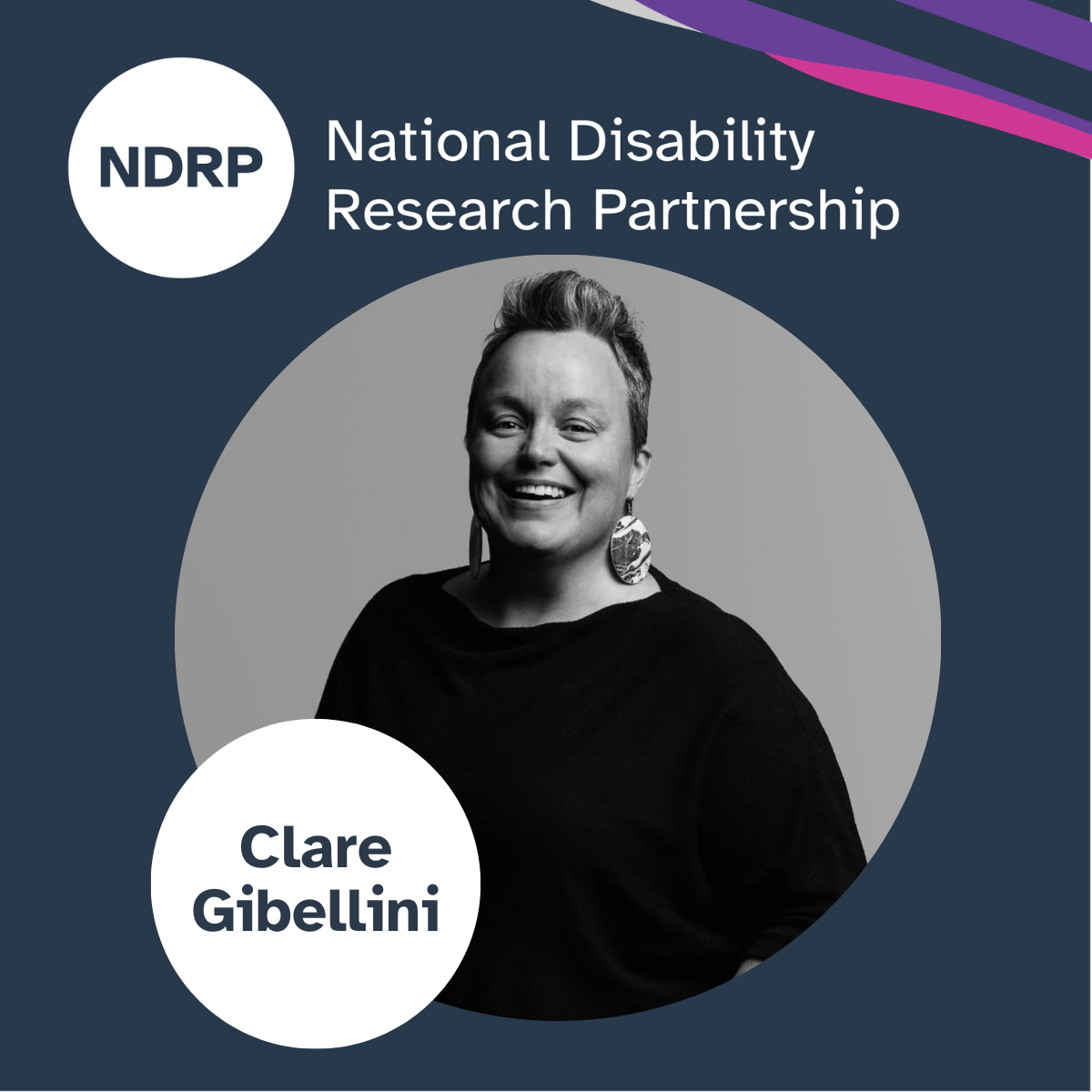
A navy blue tile with a photo of Clare Gibellini. The NDRP logo is across the top, and Clare's name is on the bottom left.

A message from our Board Chair

Clare Gibellini (she/her), NDRP Board Chair, talks more about this opportunity

Watch Clare's video (YouTube)
A navy blue background with text that says, "Independent Director of the NDRP Board and/or NDRP Research Committee Member Application Information." The NDRP logo is across the top.

Application Information (Word)

Download more information about applying for the NDRP Board and Research Committee.

Download application information (Word)
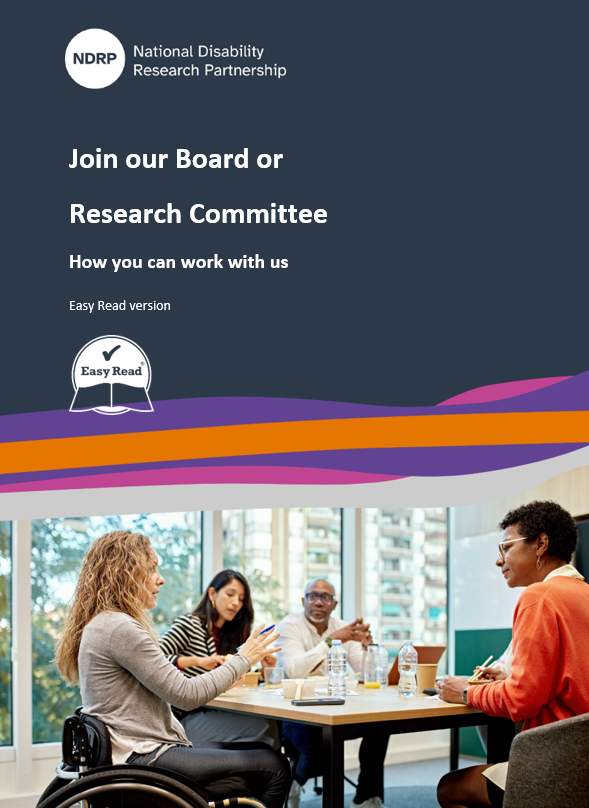
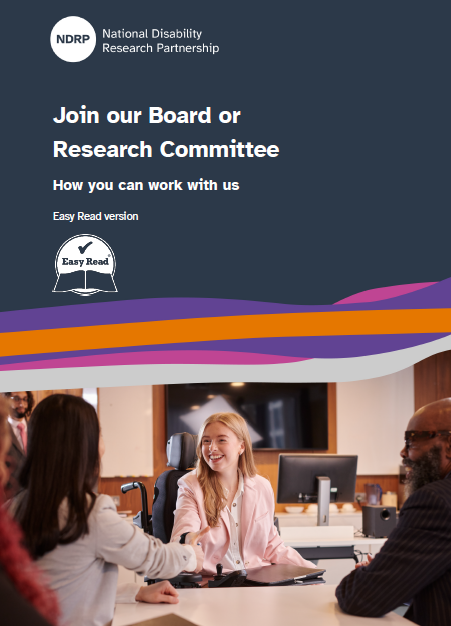
A navy blue background, that says "Join our Bord or Research Committee. How you can work with us. Easy Read version." There is a photo of people working together at the bottom.

Join our Board or Research Committee

More information in Easy Read

Download Easy Read information (PDF)
A navy blue background, that says "Join our Bord or Research Committee. How you can work with us. Easy Read version." There is a photo of people working together at the bottom.

Plain text of Easy Read document

More information in Easy Read and plain text

Download Easy Read information in plain text (Word)
A navy tile that says "Auslan videos." The NDRP logo is in the bottom right.

Auslan video for application information

Watch the video in Auslan for the key application information.

Watch the Auslan video (YouTube)
A navy tile that says "How to complete the NDRP Board and Research Committee application form in SmartyGrants." The NDRP logo is in the bottom right.

How to complete the application in SmartyGrants

Sue Tape, NDRP Deputy CEO (she/her) takes you through the questions in the SmartyGrants form.

Watch the SmartyGrants how-to video (YouTube)

Frequently asked questions

Can someone who lives outside Australia apply?
These roles are primarily intended for people who are connected to the Australian disability community and systems, as NDRP’s work focuses on improving disability policy and practice in Australia.

What does the Board do?
The NDRP Board provides governance and strategic leadership for the organisation. Board Directors help guide NDRP’s direction, ensure strong governance, and support the organisation’s mission to fund high-quality disability research led by and with people with disability.

What does the Research Committee do?
The Research Committee provides expert advice to the Board about disability research. This includes advice on research priorities, funding opportunities, research quality and impact.

Do I need to have a disability to apply?
No. NDRP values lived experience of disability and strong connections to the disability community. However, you do not need to be a person with disability to apply. We aim to bring together people with diverse expertise and perspectives.

Can I apply for both the Board and the Research Committee?
Yes. You can indicate in the application form if you are interested in both roles. During the selection process, you may be considered for one role or the other depending on the balance of skills and experience needed.

Are these paid roles?
Yes. NDRP recognises the expertise and time required for these roles. Remuneration is provided, consistent with NDRP governance arrangements. Details will be shared with successful applicants.

Do I need to prepare long written answers?
No. The application form includes word limits and guidance to help you keep responses clear and focused. You can write in short paragraphs or dot points.

When do applications close?
Applications close at: 5:00 pm AEST on 30 April 2026

Who can I contact if I have questions?
If you have questions about the application process, please contact: info@ndrp.org.au

Can someone nominate me for a role?
This opportunity is an expression of interest process, so individuals need to submit their own application. However, people are welcome to encourage or suggest that someone apply.

What happens if I submit my application and realise I made a mistake?
If applications are still open, you can contact NDRP and request that your application be reopened for editing. Please email info@ndrp.org.au as soon as possible.

Do referees need to submit a reference before I apply?
No. You only need to provide the contact details for two referees in the application form. Referees may be contacted later in the process if required.

Will applicants receive feedback if they are not successful?
Due to the number of applications expected, NDRP may not be able to provide detailed individual feedback to all applicants. However, all applicants will be notified of the outcome of the process.

Want to know more about the NDRP? Read our NDRP FAQs

Assessment Criteria

We assess applications based on skills, experience and overall contribution to the Board or Research Committee.

Applications are considered across three areas:

  • Experience in disability research aligned with NDRP’s guiding principles. This may include community-based, applied, advocacy-led, policy or academic research.
  • Experience that strengthens the Board’s and Research Committee’s understanding of disability, policy or research systems, such as work in the disability sector, partnerships with marginalised communities, governance roles, government experience, or policy and advocacy.
  • Skills relevant to governance, including leadership, strategy, governance, partnerships, communication, financial or risk oversight, legal or regulatory knowledge, and technology or innovation.

We also consider overall Board and Research Committee balance, diversity of perspectives (including lived experience of disability), and ability to act in the best interests of NDRP.


Board Director Position Description

Board Director – Independent Director National Disability Research Partnership (NDRP)

Role purpose

Independent Directors are responsible for the governance and strategic oversight of the National Disability Research Partnership (NDRP). Working collectively as the Board, Directors ensure the organisation fulfils its charitable purpose of advancing disability-led research that informs policy and practice in Australia, in accordance with the Constitution and the NDRP Guiding Principles. 

Independent Directors act in the best interests of NDRP as a whole, rather than representing any particular constituency or organisation.

Key responsibilities

Independent Directors are expected to:

  • Provide strategic leadership and oversight
    • Contribute to setting NDRP’s strategic direction and priorities
    • Oversee progress against NDRP’s objectives and research agenda
  • Uphold purpose, principles and values
    • Act consistently with NDRP’s charitable purpose
    • Uphold and embed the NDRP Guiding Principles, including valuing lived experience and inclusive leadership
  • Ensure strong governance and stewardship
    • Oversee organisational performance, financial sustainability and risk management
    • Ensure compliance with the Constitution, relevant legislation, and regulatory obligations
  • Support ethical and inclusive research
    • Promote high-quality, ethical and impactful disability research
    • Ensure research funded or supported by NDRP is inclusive, accessible and led by and with people with disability
  • Contribute to an effective Board culture
    • Participate constructively in Board and committee deliberations
    • Foster a respectful, collaborative and accountable Board culture
    • Declare and manage conflicts of interest in accordance with the Constitution

Duties and expectations

Independent Directors are expected to:

  • Prepare for and actively participate in Board meetings and committee work
  • Exercise care, diligence and good faith in line with director duties under the Corporations Act and ACNC governance standards
  • Maintain confidentiality and act with integrity at all times
  • Work collectively with other Directors, the Chair and the CEO
  • Support accessibility and participation, including reasonable adjustments where required

Appointment and term

  • Independent Directors are appointed by Board resolution, following a recommendation from the Nominations Committee
  • Appointments are for a term of up to three years, with eligibility for reappointment, subject to a maximum of two terms
  • The Board may set a shorter initial or transitional term to support continuity and succession planning

Conflict of interest expectations

Board Members must:

  • Act in the best interests of NDRP at all times
  • Declare any actual, potential or perceived conflicts of interest
  • Comply with the NDRP Conflict of Interest Policy and Related Parties policies
  • Excuse themselves from discussion where required by the Chair

Having other professional roles or community connections does not automatically prevent appointment. NDRP recognises that lived experience and sector expertise often involve overlapping roles, and conflicts are managed transparently and appropriately.
Research Committee Position Description

Research Committee Member National Disability Research Partnership (NDRP)

Role purpose

Research Committee Members provide independent expert advice and recommendations to the NDRP Board on matters relating to disability research strategy, funding, quality, and translation.

Working collectively as the Research Committee, members help ensure that NDRP’s research program is high quality, disability inclusive, transparent, and aligned with the NDRP Research Agenda and Guiding Principles.

Research Committee Members contribute their expertise as individuals and do not represent the views of their organisations.

Key responsibilities

Research Committee Members are expected to:

  • Provide strategic research advice
    • Provide independent, strategic advice to support a contemporary and responsive disability research program
    • Advise on strategic and policy frameworks for research funded by NDRP
    • Monitor and recommend updates to the NDRP Research Agenda and emerging priorities
  • Support research funding quality and integrity
    • Monitor and review research funding processes to ensure quality and transparency
    • Consider recommendations from Independent Review Panels and provide recommendations to the Board
    • Provide oversight of funding rounds, targeted research, commissioned research, fellowships and scholarships
  • Strengthen research capacity and impact
    • Provide advice on research capacity strengthening initiatives
    • Support knowledge translation and evidence-to-action strategies
    • Help strengthen disability inclusive research practice across the sector
  • Contribute to an effective committee culture
    • Participate constructively in committee deliberations
    • Bring diverse perspectives and expertise to discussions
    • Declare and manage conflicts of interest appropriately
    • Declare and manage conflicts of interest in accordance with the Constitution

Duties and expectations

Research Committee Members are expected to:

  • Prepare for and actively participate in committee meetings
  • Exercise sound judgement and act in good faith
  • Maintain confidentiality and integrity
  • Work collaboratively with other committee members, Board Directors, and NDRP management
  • Support accessibility and participation, including reasonable adjustments where required
  • Declare any actual, potential or perceived conflicts of interest at the start of meetings

Appointment and term

  •  Members are appointed by the NDRP Board following an open expression of interest process facilitated by NDRP management
  • The initial term is to 30 June 2027
  • Members may nominate for a second term

Conflict of interest expectations

Research Committee Members must:

  • Act in the best interests of NDRP at all times
  • Declare any actual, potential or perceived conflicts of interest
  • Comply with the NDRP Conflict of Interest Policy and Related Parties policies
  • Excuse themselves from discussion where required by the Chair

Having other professional roles or community connections does not automatically prevent appointment. NDRP recognises that lived experience and sector expertise often involve overlapping roles, and conflicts are managed transparently and appropriately.
Find support

Contact info@ndrp.org.auSubscribe to updates 

Want to know more about the NDRP? Visit our website